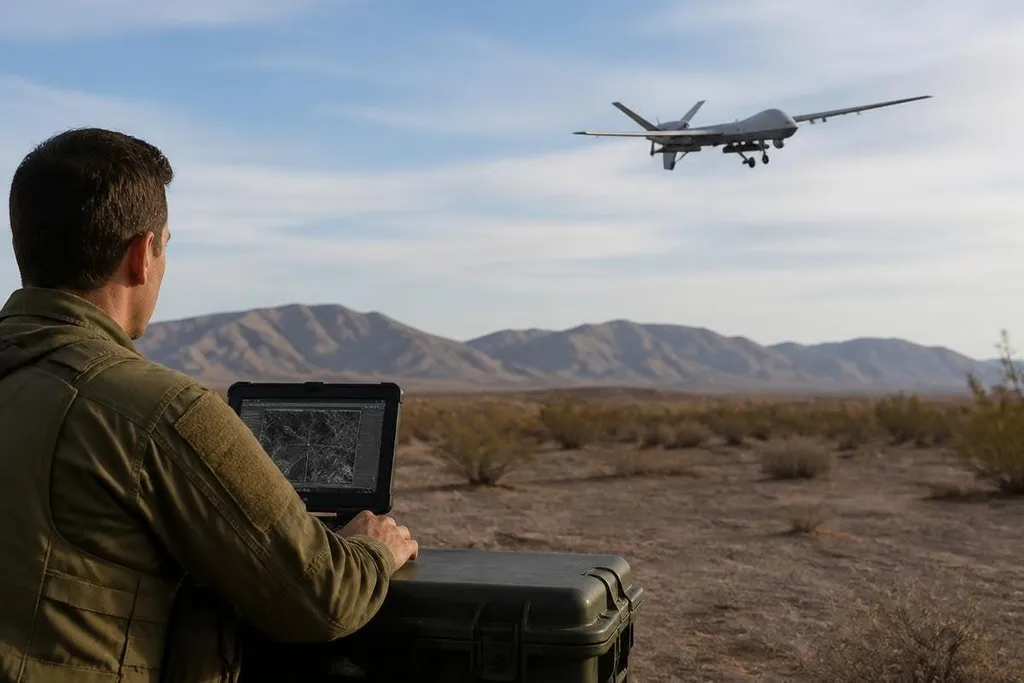
An autonomous defense drone can select a route, identify an object, and act without a person guiding every movement. That technical shift creates a hard question for military planners: who carries responsibility when software makes a lethal choice?
- A human may set the mission without choosing each target.
- A sensor error can turn an object into a threat.
- A clear stop rule matters as much as flight time.
What autonomy changes
Remote-controlled drones still depend on a person to choose where the aircraft looks and what it does. An autonomous system can make some of those choices from sensor data and software rules, which changes the speed and shape of human control.
The operator may set a search area, time limit, and task. The drone then handles movement and object matching within those limits. That can reduce the time between detection and action, but it can also shorten the time available for a person to check the result.
The ethical issue sits at that handoff. A person may approve the mission without seeing the exact object that the system later marks as a target. If the software is wrong, responsibility cannot rest on a vague claim that the machine acted on its own.
The target decision is the dividing line
Flying without direct control is one matter. Choosing a person, vehicle, or building for attack is another. The second task involves context that sensors may not have: a civilian nearby, a surrender signal, a damaged vehicle, or a change in the mission.
That context can arrive after the software has made its choice. A camera may show shape and movement, while a human may know why that movement makes sense. A vehicle leaving an area could be a threat, a rescue team, or someone trying to escape danger. The image alone may not settle the question.
This is why ethical review should focus on the point where force becomes possible. Rules written at the planning stage are not enough if no person can pause the action after the system selects a target.
My view is plain: a human should retain the power to stop a lethal action until the last practical moment.
That rule does not remove every risk. It does set a clear place for judgment, and it gives commanders a record of who approved the action and under which conditions.
Any system that cannot provide that record creates a problem for later review.
Testing cannot answer every moral question
Engineers can test sensor performance, communications, flight control, and failure handling. They can also run the software through cases with poor visibility, lost signals, and objects that look alike. Those tests matter because a system that fails in a lab should not reach an operational setting.
Testing has a limit, though. A test can show how a drone reacts to a defined case. It cannot decide whether the mission itself is lawful or whether the available information is enough for a lethal choice. Those judgments belong to people and to the rules governing the operation.
Clear records should name those boundaries and tie each claim to the drone, its software limits, and the deployment decision. Reporting on autonomous defense drones can place those details in public view, leading to the next check: what the system sees, what it misses, and who can stop it.
A useful review should ask what the system can see, what it cannot see, and who can stop it. It should also state the operating limits in words that an outside reviewer can check.
Questions for a procurement review
Before a defense agency approves an autonomous drone, its review team should answer these points:
- Name the human decision-maker for target approval and the final stop action.
- Set the exact conditions that pause the mission, including lost communication and uncertain identification.
- Record the sensor data shown to the operator before force is used.
- Test cases with civilians, damaged equipment, poor weather, and changing orders.
- Keep logs that show each software decision, operator action, and system alert.
- Define who investigates a failed identification and who can suspend the system afterward.
These checks connect ethics to machine behavior. They also expose a common gap: a policy may promise human oversight while the interface gives the operator too little time or information to act.
The next question is not whether a drone can fly and choose a route by itself. It is whether a human can still make a real decision before force is used, with enough time, data, and authority to stop the action.